
Construction Curiosities #141
How to Prove a Delay and Get Paid

Hey! What’s up?! Matt here.
Welcome back to another Construction Curiosities Newsletter.
The teaser posts for this article I put out on Social Media stirred up quite a reaction… which proves there’s still a lot of learning to do in this industry. Hope you read this one with a growth mindset.
Summary
This week we will look at:
One Musing: How to Prove a Delay and Get Paid
ConTech Corner: Can AI create a P6 Schedule?
One Meme: Controversial Topic?
How to Prove a Delay and Get Paid
A straight-talk guide to Time Impact Analysis, fragnets, and how to get paid on your Delay Claim
A PM walks into the OAC meeting with a stack of RFIs, a fat email chain, and the kind of confidence that only comes from being right. He says the magic words: “We’re owed twenty-five days.”
The owner’s rep sets down her pen and asks one question.
“Can you show me on the schedule?”
The room goes quiet. The PM has a delivery log. He has a story. He has a guy from the field who’ll swear under oath that the steel was delayed eight days. What he does not have is a Time Impact Analysis. And that is where his claim dies.
This is for both sides of that table. For contractors and subs who need to prove a delay so it actually pays. For owners and Owner’s Reps who need to know what to demand before they sign the extension.
78% of construction firms had at least one delayed project last year (AGC, 2025). The average U.S. construction dispute is now worth $60.1 million and takes 12.5 months to resolve (Arcadis, 2025). The single most common reason a contractor’s delay claim gets denied isn’t that the delay didn’t happen. It’s that nobody could prove, on the schedule, that the delay actually drove the completion date.
That’s the gap a Time Impact Analysis is built to fill.
What a Time Impact Analysis Actually Is
A TIA is a forward-looking schedule analysis. The industry standard is AACE Recommended Practice 52R-06. The Society of Construction Law’s Delay Protocol recommends the same approach. Both documents are long. The idea behind them is short.
You take the schedule that was current on the day the delay event happened. Not the original baseline. Not the as-built reconstruction you’ll build two years later when the lawyers show up. The schedule that was alive in P6 (or your preferred scheduling software) the day the change order or other delay started.
You model the delay event as a small network of activities. That’s called the fragnet.
You drop the fragnet into the schedule, link it to the right predecessor and successor activities, and re-run the CPM logic.
You compare the new completion date to the pre-impact completion date. The difference is the delay’s impact.
Current schedule + modeled delay event (fragnet) + re-run CPM = defensible time impact.
Screenshot that.
Meet the Fragnet
A fragnet is a small, self-contained chunk of activities, with their own durations, logic ties, predecessors, and successors, that you insert into the master schedule to model what a specific event added. Think of it like a Lego brick. The schedule is the model. The fragnet is the new piece you snap in.
A real fragnet contains more than just “the bad thing.” It contains all the work the bad thing actually caused.
For example: You’re framing the third floor. Three weeks in, the owner swaps the structural steel detail at column line C. That’s not a single 25-day activity called “Owner Change.”
That’s a whole sequence of events: stop work at column line C, submit RFI, EOR responds in five days, revised shop drawings in four, two beams re-fabricated in ten, re-erection in two, re-inspection in one, then resume framing.
That sequence, properly linked, is the fragnet. Twenty-five days of activities. You snap it into the schedule and re-run CPM.
And here’s the moment that wins or loses you the claim: maybe the schedule only pushes by eighteen days, not twenty-five, because seven days of that fragnet ran in parallel with other work that had float. The eighteen days is the answer. Not twenty-five. Not “about three weeks.”
Eighteen.
The math is the math. You can argue about the inputs. You can’t argue with the output.
Float, Critical Path, and Why General Conditions Are Not a Given
A delay that gets absorbed by float doesn’t drive the completion date. A delay that consumes all available float and lands on the critical path does. Only the second kind is a compensable time impact.
This is also where the added general conditions conversation actually belongs.
A lot of contractors treat extended GCs like a given... You delayed me, so I get more days, and along with those days I get extended GCs. That is not how it works. You get extended general conditions for the days the project is actually extended past substantial completion. Not the days you felt the pain. The days the contract end date moved.
If the change order fragnet is inserted into the schedule and doesn’t impact the critical path and therefore doesn’t impact the substantial completion date, then sorry you don’t get added General Conditions.
If the delay event consumed float but didn’t push substantial completion, the GCs clock doesn’t restart. If the delay event pushed substantial completion by 18 days, you get 18 days of GCs. Not 25. Not the round number on the original delay letter. The number the schedule supports.
The TIA establishes the days. The days establish the GCs. The GCs get priced. You don’t get to skip step one and start at step three.
All this is to say, that if the added work requires certain general conditions specific to that added scope (maybe a new security fence or required added supervision). Then itemize and show it. A Time Impact Analysis isn’t a case for getting something free from the Contractor just because it didn’t move Substantial Completion.
But what do the Courts say about this?
In 2022, the Armed Services Board of Contract Appeals gave contractors a pretty blunt reminder in Appeal of Wright Brothers, The Building Company, Eagle LLC:
A time extension does not equal money. You may get excusable time without proving compensable delay.
Wright Brothers had a renovation project at Minot Air Force Base. The original contract was around $3.8 million, and the project was supposed to take 365 days. Instead, the job dragged on for almost four years. Not exactly a minor schedule adjustment.
Eventually, Wright Brothers submitted a delay claim seeking roughly $754,000. After some back and forth, the remaining amount in dispute was about $455,000 in alleged government-caused delay costs. Their argument was pretty straightforward: the Air Force granted time extensions, so the Air Force must have caused the delay, and if the Air Force caused the delay, Wright Brothers should be paid for the extended costs.
That seems logical enough on the surface.
Unfortunately, construction delay claims are where surface-level logic goes to get beaten with a scheduling specification.
The Board did not buy it. The problem was not that the contractor failed to show the project was delayed. The project clearly took way longer than originally planned. The problem was that Wright Brothers’ expert did not perform a critical path analysis. He argued one was not required because the government had already granted the time extensions.
That is where the whole claim fell apart.
The Board found the expert’s opinions were “of little benefit in deciding this appeal” and said Wright Brothers provided “no context to support a finding that the alleged delays and disruption ran through the project’s critical path.” In normal human words, the contractor did not connect the alleged government delays to the sequence of work that actually controlled project completion.
That’s what most of the industry misses… A change can be real. An RFI delay can be real. A late owner decision can be real. A time extension can be real. And you can still lose the money claim if you cannot prove that delay actually pushed the critical path.
The timeline matters here too. The claim started with a 2019 contracting officer’s decision. There was an early 2020 jurisdiction fight over whether the claim certification issue blocked the appeal. The Board allowed the case to move forward, but when it finally reached the merits in the December 30, 2022 decision, Wright Brothers still lost the remaining delay claim because the proof was not there.
Government Construction Law Update summed up the body of case law pretty perfectly:
“No critical path analysis for a contractor delay claim? Expect your claim to be denied.”
That should be a wake up call for the whole industry.
To recover delay costs, you generally have to prove the delay was excusable, compensable, on the critical path, and not concurrent with a delay you caused yourself. A properly prepared Time Impact Analysis helps prove those things using the schedule, the fragnet, and the information available when the delay happened.
A strongly worded letter does not.
A binder full of emails does not.
A meeting where everyone “agreed we were delayed” does not.
And a change order that adds days does not automatically add general conditions.
Cool. They gave you time.
Now prove the delay hit the critical path.
RTFC, then re-run the schedule.
What to Do Before the Lawyers Get Involved
Contractors and subs: Do the TIA the month the delay happens. While the steel is still sitting on a truck somewhere in Ohio. While the RFI is still warm. The cost to run one in the moment is a tiny fraction of the cost of fighting about it for 12.5 months later. Prove your delay will its active and fresh in everyone’s mind. Document. Document. Document.
Owners and Owner’s Reps: When a delay claim shows up, ask for the homework: The schedule update. The fragnet. The before and after CPM versions side by side. The honest answer about concurrent delay.
And remember: extended GCs aren’t a sympathy payment for a rough month. They’re compensation for the days the contractor is actually on your site past the contract end date. If the schedule re-runs to 18 added days, the GCs get paid for 18 days. Not the 25 in the delay letter. The number the schedule supports.
Real contractors with a real claim will respect the process. Contractors without one were hoping you wouldn’t know to make the ask.
The Real Bottom Line
A delay is not automatically a claim. A Time Impact Analysis is what turns the first into the second.
The schedule tells the story of what was supposed to happen. The fragnet shows what changed. The TIA connects the two and answers the question everyone wants to argue about:
Did this actually move the critical path?
Because without that answer, you don’t have a delay claim. You have a complaint with attachments.
And before you come at me telling me this isn’t “fair.” Just remember I didn’t create the game. I’m just trying to teach you the rule book. What you do from here is up to you.

ConTech Corner

If you’ve ever been handed a 15-page PDF “schedule update” from a GC that tells you basically nothing, or watched a project manager disappear at 9pm to update P6 after the kids went to bed… this one’s for you.
On May 28th at Noon Central, I’m going live with Jonas Ebrahimi, founder of Karmen AI, to look at what an AI co-pilot for construction scheduling actually looks like in practice.
Not a sales pitch… we’re going to put it through its paces together: baseline schedules, change order analysis, time impact analysis, and what it means for owners trying to make sense of the schedule they’re being handed.
If you’re a GC, specialty sub, or owner’s rep who’s ever thought “there has to be a better way to deal with this” come check it out.
RSVP on LinkedIn: HERE
RSVP on YouTube: HERE
See you there!
PS - If you can’t wait til the end of the month and want to check a personal demo with Jonas, you can schedule that on his Calendly link here:
Schedule a Karmen AI Personal Demo
One Meme
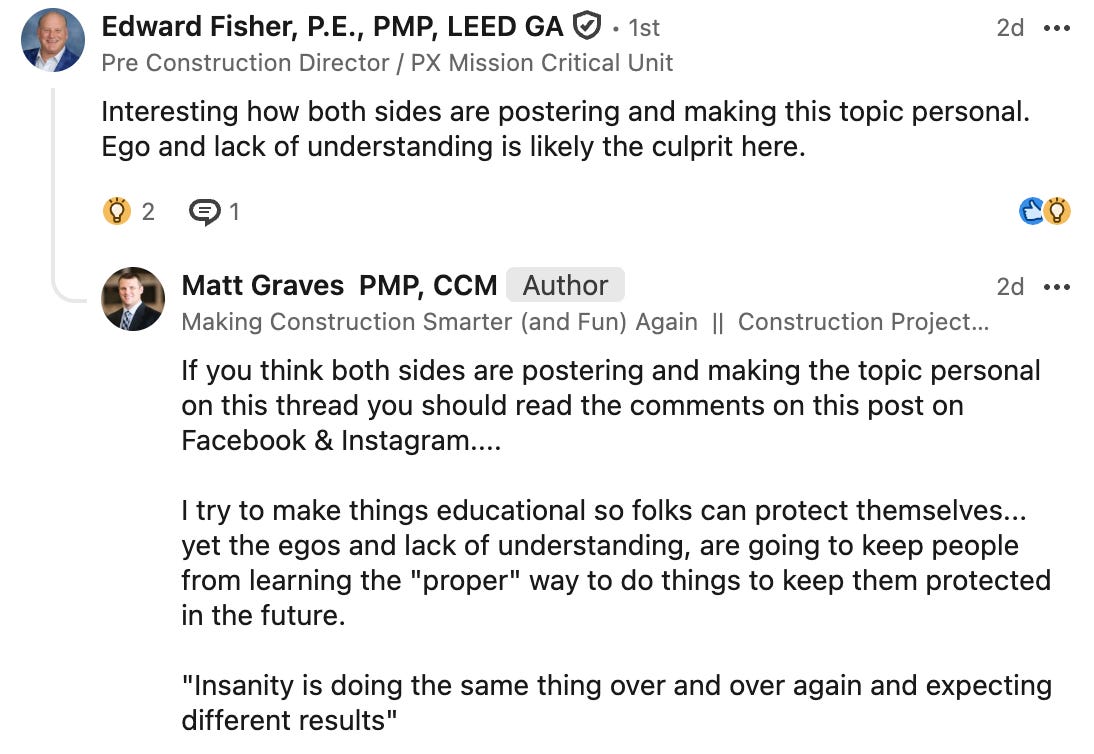
The comment section on this post turned into an interesting one… I think this summed it up well:
Construction Curiosities is a reader-supported Newsletter. Please consider upgrading your subscription to help support the work we are doing. With your support, we can keep providing entertaining yet educational Construction content!
See y’all next time! ✌

Long short. Paper up, become documented. Everyone sucks because of american economics.