Construction Curiosities #135
The Most Scarce Resource in Construction

Hey! Happy Saturday! Matt here.
Welcome back to the Construction Curiosities newsletter!

Hope everyone had a great Holiday season, got everything cleaned up, and are having an awesome and productive start to 2026!
This week’s newsletter is brought to you by The Contractor Consultants. They make construction hiring faster, smarter, and way more affordable by vetting top talent for your team, cutting out inflated recruiter fees, and managing nearly all the hiring work so you can focus on building instead of sifting through resumes.
Summary
This week we will look at:
One Musing: The Most Scarce Resource
One Video: CY meets TCC
One Meme: I believe
The Most Scarce Resource in Construction Isn’t Steel or Switchgears
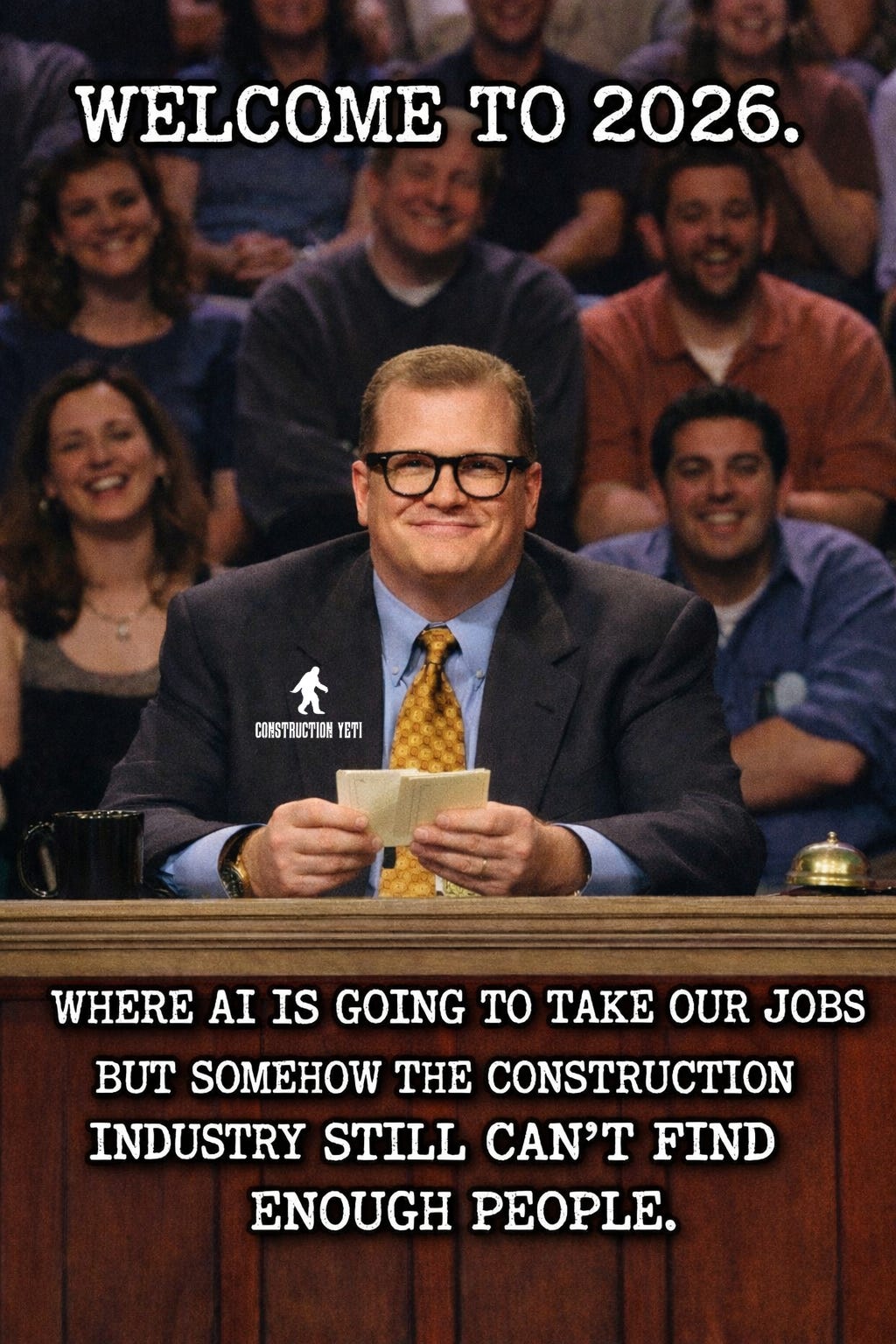
I was talking with a construction management student this week. At one point he mentioned that it’s pretty normal now for CM students to have 10 to 15 internship offers.
He wasn’t bragging. Just stating reality.
That stopped me for a moment, mostly because of how different things looked when I came out of school.
I graduated in 2010. My prime internship years were 2008 and 2009, right in the middle of the recession. I had one internship interview. I didn’t get it. When I graduated, it took me a couple of months to land my first job, and when I finally did, I was relieved. I was very close to taking my civil engineering degree and waiting tables or bartending.
Some of my friends never even entered the construction industry, deciding to go other routes. Others stayed in school longer, picked up master’s degrees or extra certifications, hoping the job market would look different by the time they came back out.
Fast forward to today, and the pendulum has completely swung the other way.
Welcome to the Construction Market of 2026
Construction is booming across nearly every market.
Backlogs are full. Schedules are tight. Everyone is busy.
In Texas and across much of the South, data centers are vacuuming up talent and resources at a staggering pace. Field leadership, project managers, engineers, and especially electrical and mechanical trades are being pulled aggressively. They’re paying top dollar to do it.
This isn’t good or bad. It just is.
And the data confirms what everyone feels anecdotally.
According to Associated General Contractors of America, more than 80% of construction firms report difficulty filling both salaried and hourly positions, including project managers, superintendents, and craft professionals.
Associated Builders and Contractors estimates the industry needs to attract over 500,000 additional workers per year just to meet current demand, not accounting for retirements.
Meanwhile, U.S. Bureau of Labor Statistics continues to show historically high construction job openings paired with low unemployment. In other words, companies aren’t competing with the unemployed. They’re competing with each other.
There simply aren’t enough people to cover all the work that’s happening. And this isn’t a new conversation. To some point, it’s been “the” conversation on Social Media for years as everyone preps the coming baby boomer cliff. And as demand ramps up, that cliff is getting higher and higher.
Why This Makes Everything Harder
The problem isn’t just finding enough bodies, it’s finding quality folks you can trust to plug straight in, and help your business thrive.
Scarcity makes A-plus talent harder to find and even harder to retain. Everyone ends up fishing in the same small pond, and then the pressure shows up:
Existing employees take on more work.
Teams get stretched thinner.
People manage more projects than they reasonably should.
At first, it looks like increasing productivity.
Over time, it turns into burnout.
Burnout leads to mistakes. Mistakes lead to frustration. Frustration leads to turnover. And turnover only makes the original problem worse.
How Companies Are Trying to Solve the Problem
There isn’t a single silver bullet. What companies really have are levers they can pull. Each one has pros and cons, and most are being misapplied.
1. Day Labor
Day labor fills an immediate gap in unskilled labor. It’s fast, flexible, and transactional by design.
That’s both its strength and its limitation.
Pros
Quick access to manpower
Useful for short-term, unskilled tasks
No long-term commitment
Helps crews keep moving in a pinch
Cons
No loyalty or ownership
No connection to company culture
Limited skill depth
Not suitable for leadership or skilled trade work
Day labor is a tactical tool. Even when they promise skilled labor, don’t buy it. Real skillful people want more from their employer than bouncing job to job and a culture that truly values and invests in them.
2. Recruiters and Headhunters

Recruiters & headhunters can work, especially when they’re internal to the company.
Third-party recruiters can help too, but they come with incentives that don’t always align with long-term success.
Pros
Expands reach beyond immediate networks
Can move faster than internal teams
Helpful for hard-to-fill or senior roles
Internal recruiters deeply understand company culture
Cons
Third-party fees are expensive
Incentives favor placement over fit
Onboarding and retention risk stays with the company
Quality varies widely between firms
Recruiters are a lever. They’re rarely a strategy by themselves.
3. Employee Referral Programs
Referral programs work when employees trust the system and feel protected.
Good people know other good people, so make the system worth their time and effort to bring their connections in.
Pros
Higher likelihood of cultural alignment
Faster trust curve
Stronger retention when done right
Turns employees into talent (and brand) advocates
Cons
Incentives are often too small to motivate the employee to act
Fear of blowback discourages referrals
Poor communication kills participation
The key is clarity. Once a referral is made, responsibility must transfer 100% to the company. If employees think a bad hire reflects on them, referrals dry up fast.
4. Talent Acquisition Marketing (The Long Game)
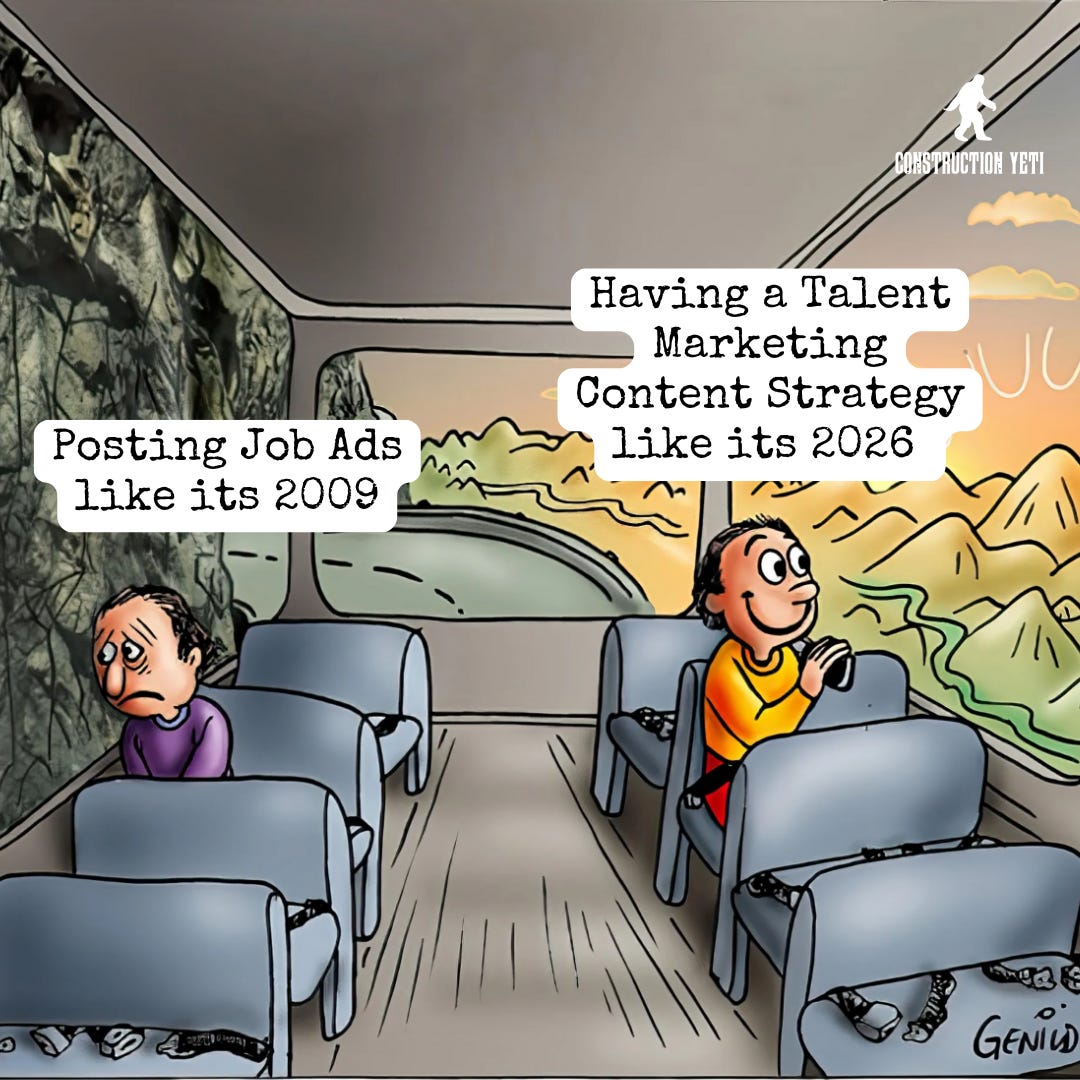
This is the most overlooked and most effective lever over time.
Good talent absolutely pays attention to brand, culture, and reputation, but most of the time the Marketing for new hires is left to HR. I get why, but… Nearly all HR professionals (while being great at what they do), don’t know how to relate to the men and women who actually work in this industry. Your field, project management, and operations people need to be the ones front and center in the Talent Acquisition Marketing content creation.
Pros
Attracts higher-quality candidates organically
Again A+ talent, wants to go to A+ firms
Improves retention, not just hiring
Strengthens reputation in the market
Compounds over time
Cons
Takes some time to show results
Requires leadership involvement, not just HR
Doesn’t solve immediate staffing emergencies
Needs authentic voices from the field
I really see this as a Pro, but some companies might struggle with the idea of pulling the Guys/ Gals out of the field for a minute to highlight the awesome work they are doing.
This isn’t about glossy slogans. It’s about leaders, PMs, and field teams showing what work actually looks like and why people stay. Don’t make them lie or stretch the truth. Build a culture they are proud to represent.
TEASER: This is so wildly important in 2026 and beyond that AltCMO, is about to launch a Content Creation Program that puts Companies in the Driver Seat of becoming the authority in your market.
More from me on this soon, but if you can’t wait and are ready to learn more about investing in your Talent Acquisition Marketing, let me know and I’ll fill you in on what’s coming!
Innovative Solutions
When everyone has the same struggles, sometimes you need to think outside the box. Try something different than the rest of the industry is doing. Things like:
Trying TCC (more on them below) instead of traditional Recruiters and Labor firms.
Creating a Military Veterans to Construction training program. There are 200,000 U.S. military service members who transition out of the military every year. Many struggle to discover how their military experience and skills can translate to civilian roles.
Spoiler: Military skills such as Leadership, Team Work, Reliability, Planning & Execution, and Communication under pressure are super valuable skills that everyone in the Construction industry must have.
Developing Specific Strategies to target and attract the Next Generation coming into the industry.
Spoiler: On the Project Management side, simply showing up at job fairs isn’t going to cut it any more. Not when each student has 15 offers on the table.
The Silent Killer: Retention
Hiring gets the attention. Retention does the damage.
If you can’t retain good people, you’re forced to hire constantly. And construction is a small world. Word travels fast.
People know which companies burn teams out.
People know which companies take care of their own.
A-plus players don’t want to join sinking ships. They want stable teams, reasonable workloads, and leadership that understands the human side of the business.
When retention fails, everything compounds in the wrong direction.
Final Thought
This is the game now.
People are the most scarce resource in construction. Companies still playing by yesterday’s rules might not feel it immediately, but five years from now the gap will be impossible to ignore.
And it’s not just a “labor problem” anymore.
Quietly, the industry is entering a technological arms race. But it’s not just about adopting the newest and shiniest AI widget.
Companies that adopt new tools without training in the fundamentals will create button-pushers who don’t understand the work. Companies that refuse to adopt new tools at all will look completely outdated to the next generation.
It’s hard to imagine someone who made it through college with ChatGPT as a daily companion being excited to work for a company that shuns AI and insists everything be done the same manual way it was in the 90s.
At the same time, we don’t need a workforce of AI jockeys who don’t know what they’re actually doing. The next generation still needs to understand the basics well enough to spot bad inputs, bad assumptions, and hallucinations when the tools get it wrong.
The companies that win won’t choose between technology, training, or marketing.
They’ll do it all.
Most companies may not recognize it yet, but this arms race is already underway. And the prize isn’t productivity. It’s the Next Generation of Talent.
I’m curious what’s actually working for you.
What have you tried?
What surprised you?
What failed?
Because in 2026, hiring isn’t really an HR problem.
It’s a leadership one.
One Video
The construction labor shortage gets talked about a lot. And is only going to get more air time.
Most of the advice floating around isn’t wrong. It’s just not real helpful when you’re dealing with staffing problems right now. Like need someone yesterday type of right now.
Yes, apprenticeship programs matter. They’re critical for the long-term health of the industry. But they don’t solve the job you’re understaffed today.
Yes, training and career development matter. But that assumes you already have enough PMs, supers, and field leaders to train.
Yes, better work-life balance helps with retention. But retention only works if people actually know your company exists and want to work there.
All of those things are necessary. None of them help much when today’s fires keep you from ever getting ahead.
That’s the loop a lot of contractors are stuck in. You can’t invest in people because you don’t have enough people. And you can’t get enough people because you can’t invest in them.
Staffing firms are often the next lever contractors pull. Sometimes they help. Many times they don’t. Fees are high, expectations are higher, and results are mixed.
That’s why I was skeptical when The Contractor Consultants reached out.
So when The Contractor Consultants reached out, I was skeptical. They promised a solution that was faster, cheaper, and better quality. Everyone who works in Construction knows you can only pick 2. So I thought it was BS.
What changed my perspective was seeing how they actually operate.
They aren’t a traditional recruiter. They’re a done-for-you hiring service focused specifically on construction roles. Their team comes from the industry, which matters more than most people realize. They know what to look for, what questions to ask, and where candidates usually fall apart after hiring.
Their DFY hiring service makes 3 hires per month for a flat, monthly fee that’s 1/10 the cost of a recruiter. It’s practical. It’s affordable. It actually helps contractors breathe again.
If it sounds too good to be true, check ‘em out for yourself here: The Contractor Consultants
Enjoy the Construction Yeti’s latest adventure courtesy of TCC:

One Meme
This one hit over 1 million views across platforms this week…
I guess you could say it resonated 😆

Construction Curiosities is a reader-supported Newsletter. Please consider upgrading your subscription to help support the work we are doing. With your support, we have more big things planned and in the works.
See y’all next week! ✌